
 Written by
 Organizations investing in Dynamics 365 Sales often face a familiar challenge: integrating their existing ERP systems such as Epicor, SAP, Oracle, Microsoft Dynamics 365 Business Central, Infor, or custom legacy applications with their CRM platform.
Unfortunately, many integration projects start with good intentions but quickly become difficult to maintain. Every ERP requires different field mappings, custom code, lookup logic, and business rules. As businesses evolve, integration costs continue to rise.
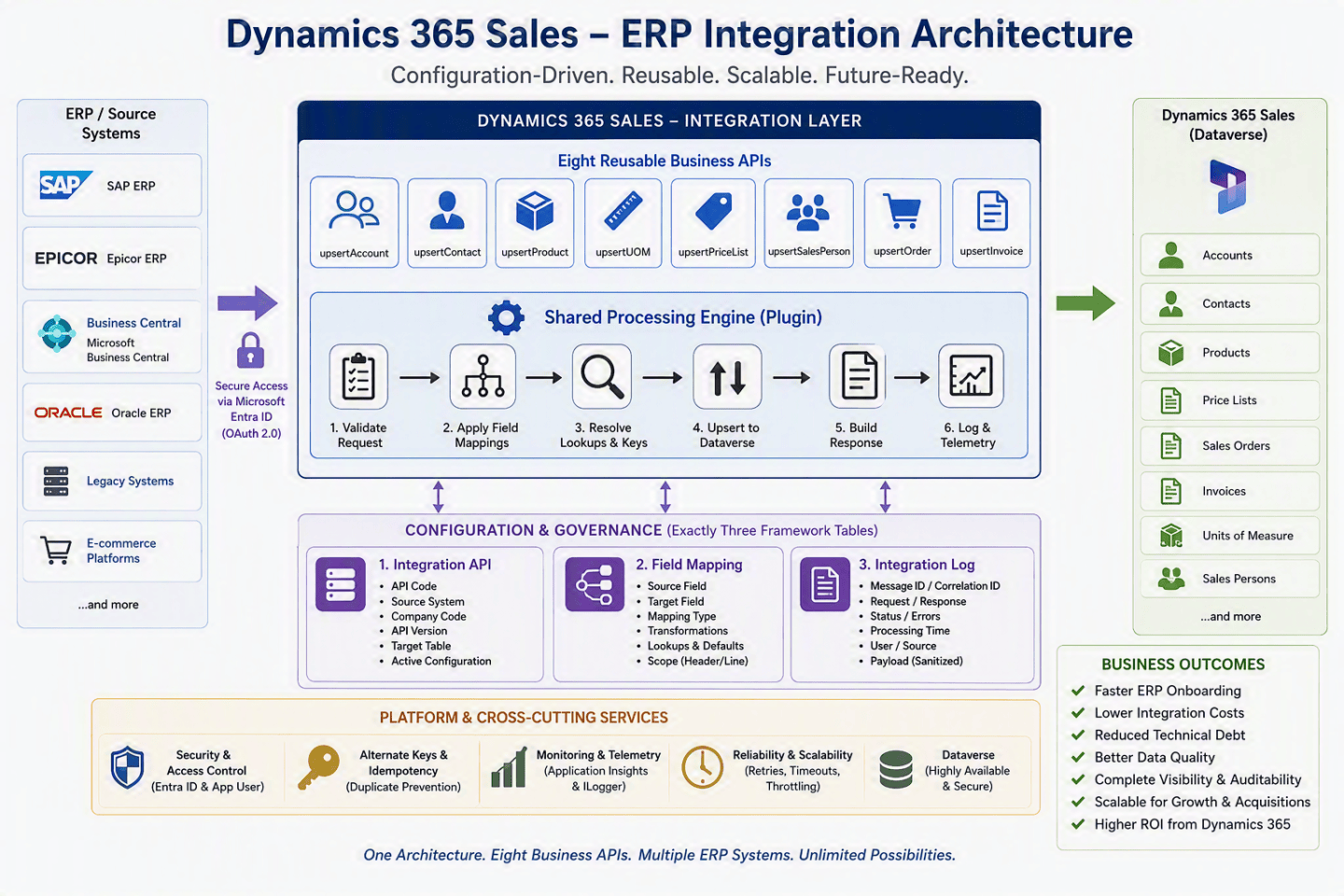
At Dynatecon, we recently designed a Configurable Integration Framework for Dynamics 365 Sales and Microsoft Dataverse that addresses these challenges head-on. Instead of building a new integration for every ERP system, organizations can implement a reusable, configuration-driven framework that dramatically reduces integration effort, maintenance costs, and implementation risks. Based on the technical architecture defined in, the solution uses stable business APIs, a shared processing engine, and configuration-driven mappings maintained within Dataverse.
The Common Problem with CRM-ERP Integrations
Many organizations still rely on integration models that involve:
- Custom API development for every entity
- Hardcoded field mappings
- ERP-specific business logic
- Duplicate validation routines
- Multiple integration codebases
- Limited monitoring and diagnostics
As a result:
- Every ERP onboarding becomes a mini-project
- Changes require development effort
- Support costs increase over time
- Testing becomes repetitive and expensive
- Technical debt accumulates
The business ends up paying repeatedly for essentially the same integration capability.
Introducing a Configuration-First Integration Framework
The framework is built around a simple principle:
Keep APIs stable. Move mapping and integration behavior into configuration.
The architecture provides eight business-focused APIs covering the most common master and transactional entities:
- Customer Accounts
- Contacts
- Products
- Units of Measure
- Price Lists
- Salespersons
- Sales Orders
- Invoices
Instead of creating separate integration logic for each source system, a shared processing engine reads configuration stored in Dataverse and dynamically determines how data should be validated, transformed, mapped, and synchronized. The design defines eight stable business APIs supported by a single shared processing engine, while field mappings and transformation behavior are maintained through Dataverse configuration.
Key Benefits for Organizations
1. Faster ERP Integration Projects
Whether you’re integrating:
- Epicor ERP
- SAP
- Business Central
- Oracle
- Legacy ERP
- E-commerce platforms
the framework eliminates the need to redesign integration architecture each time.
New ERP systems can be onboarded primarily through configuration rather than extensive redevelopment.
Business Impact:
✅ Faster implementation timelines
✅ Lower consulting costs
✅ Reduced project risk
2. Stable APIs that Never Need Rebuilding
The solution exposes business-oriented APIs such as:
- upsertAccount
- upsertContact
- upsertProduct
- upsertOrder
- upsertInvoice
These APIs remain stable while field mappings evolve independently. The framework explicitly separates API contracts from source-specific mappings and validation rules, allowing mappings to be changed without redesigning the API layer.
This means:
- ERP upgrades become easier
- CRM changes require fewer code modifications
- New fields can often be supported through configuration
Business Impact:
✅ Lower change management costs
✅ Simplified ERP upgrades
✅ Future-proof architecture
3. Configuration Instead of Code
One of the most powerful capabilities is the configurable field mapping layer.
Examples include:
- CustomerNumber → CRM Account Number
- SalesPersonCode → CRM Owner
- ProductCode → Product Lookup
- CurrencyCode → Currency Reference
The framework stores source-to-target mapping rules, lookup behavior, transformations, default values, validation settings, and value translations within a dedicated Field Mapping configuration model.
Business Impact:
✅ Reduced development dependency
✅ Easier maintenance
✅ Faster deployment of new business requirements
4. Support Multiple ERP Systems Simultaneously
Many organizations operate:
- Multiple legal entities
- Multiple ERP instances
- Regional ERP deployments
- Acquired business systems
The framework supports configuration selection using:
- Source System
- Company
- API Version
- Business Operation
Integration configuration is selected by operation, source, company, and version, enabling different integration behaviors without modifying the underlying processing engine.
Business Impact:
✅ Supports global rollout strategies
✅ Simplifies mergers and acquisitions
✅ Enables phased ERP modernization
5. Built-In Upsert and Duplicate Prevention
A common integration challenge involves duplicate records.
This framework leverages Dataverse alternate keys and idempotent processing to ensure:
- Existing records are updated
- New records are created
- Duplicate messages are detected
- Retries do not create duplicate data
The design includes alternate-key driven upsert processing and Message ID based idempotency controls with payload hash validation.
Business Impact:
✅ Improved data quality
✅ Reduced duplicate records
✅ Reliable transaction processing
6. Enterprise-Grade Monitoring and Troubleshooting
One of the biggest pain points in integration projects is troubleshooting failures.
This framework includes:
- Integration logging
- Correlation IDs
- Message tracing
- Execution diagnostics
- Application Insights telemetry
The architecture incorporates an Integration Log for execution traceability and supports Application Insights telemetry for performance, dependency, and failure analysis.
Business Impact:
✅ Faster issue resolution
✅ Improved supportability
✅ Better operational visibility
7. Reduced Long-Term Ownership Cost
Traditional integrations become increasingly costly to support as business complexity grows.
By standardizing integrations through:
- Reusable APIs
- Shared processing engine
- Central mapping layer
- Reusable security model
- Standard monitoring
organizations avoid repeatedly funding the same integration development effort.
The framework is intentionally designed as a reusable solution package containing APIs, security, configuration tables, and deployment assets.
Business Impact:
✅ Lower TCO (Total Cost of Ownership)
✅ Reduced technical debt
✅ Higher ROI from Dynamics 365 investments
Ideal Use Cases
This framework is especially valuable for organizations that:
- Are implementing Dynamics 365 Sales alongside an existing ERP
- Need to integrate multiple ERP systems
- Anticipate future acquisitions or ERP changes
- Require a scalable API-led integration strategy
- Want to reduce dependency on custom integration code
- Need faster onboarding of new business entities
Industries such as distribution, manufacturing, retail, wholesale, healthcare, banking, and professional services can benefit significantly.
Why This Matters Now
CRM and ERP systems are no longer isolated applications. Modern organizations demand real-time visibility across customer, product, quotation, order, invoice, and pricing data.
The question is no longer:
“Can we integrate Dynamics 365 Sales with our ERP?”
The real question is:
“How can we create an integration strategy that remains maintainable, scalable, and cost-effective over the next 5 years?”
A configuration-first integration framework provides exactly that foundation.
Ready to Accelerate Your Dynamics 365 Sales Integration?
At Dynatecon Solutions, we help organizations implement scalable integration architectures for Dynamics 365 Sales, Microsoft Dataverse, Business Central, SAP, Epicor, Oracle, and legacy ERP platforms.
Our configurable integration framework enables faster deployment, lower maintenance costs, and a future-ready integration strategy.
Interested in assessing your ERP integration requirements? Contact Dynatecon for a complimentary Dynamics 365 Sales Integration Architecture Workshop and discover how quickly your ERP can be connected to Microsoft Dynamics 365.

